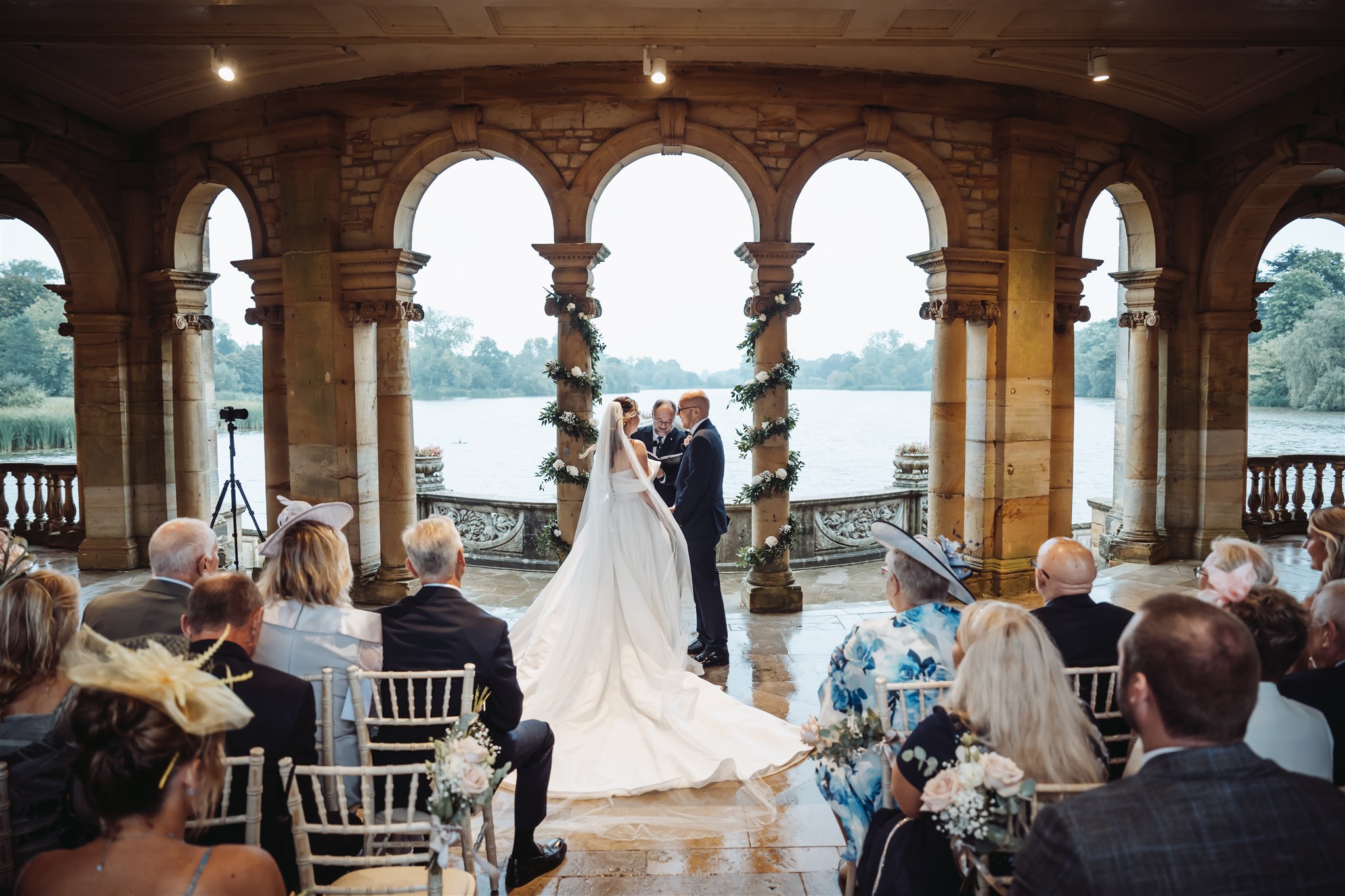
The flutter of silk as you step into your dress. Candlelight softening the room at supper. The moment your partner sees you across the aisle and the world seems, briefly, to fall quiet. These are not moments that need to be made louder. This guide to wedding film photography is for couples who want them remembered with depth, tenderness and a sense of atmosphere that will still feel beautiful decades from now.
Film has a particular way of holding a wedding day. Its colour is nuanced, its grain is gentle, and its response to light feels organic rather than overly polished. It is not simply a nostalgic look applied after the fact. It is a thoughtful, intentional medium that asks your photographer to see the day carefully before pressing the shutter.
Why film feels so at home at a wedding
A wedding is full of fleeting contrasts: a grand country house softened by rain at the windows, modern tailoring against old stone, champagne in bright afternoon sun, and a candlelit first dance long after dark. Film renders those shifts with a warmth and restraint that can feel deeply romantic.
Rather than chasing perfect sharpness or ultra-bright colour, film often honours the atmosphere of a scene. Highlights can glow. Skin tones remain soft and luminous. Texture in a lace sleeve, a hand-torn menu or the worn steps of a family church carries its own quiet character. The result is imagery that feels less like a record of every detail and more like a return to the feeling of being there.
That does not mean film is inherently better than digital photography. It is different. Digital offers remarkable flexibility in fast-changing light and allows a photographer to work at speed during moments that cannot be repeated. Film introduces a slower, more deliberate rhythm. For many luxury weddings, the most considered approach is a blend of both, using each medium where it is strongest.
What wedding film photography actually looks like
It is easy to associate film with faded colour or heavily stylised images. Beautiful wedding film photography should be more enduring than a passing visual trend. It may have fine grain, creamy highlights and a natural softness, but it should still honour the true mood, palette and setting of your celebration.
At a summer wedding in Sussex, that might mean the pale green of a garden, the blue-grey of an English sky and the warmth of late sunlight across a stone terrace. At a destination celebration, film can bring an elegant cohesion to whitewashed walls, rich florals and bright Mediterranean light without making every image feel identical.
The beauty lies in its variation. A portrait may feel composed and editorial, while the image beside it captures your father adjusting his cufflinks or your friends laughing during speeches. The best galleries move between refined portraiture and unguarded emotion, creating a love story that feels polished but never overworked.
Grain is part of the language
Film grain is not a flaw to be removed. It is part of the texture that gives an image life. In lower light, it can become more visible, particularly in evening photographs, and this lends a softness that suits candlelit rooms and dance floors beautifully.
If your priority is clinical sharpness in every frame, film may not be the natural fit for your entire gallery. If you are drawn to images with soul, movement and a tactile quality, that very imperfection may be exactly what you love.
Light shapes the final image
Film responds beautifully to good light, but good light does not only mean sunshine. Window light while getting ready, open shade for portraits, a ceremony held beneath trees and tables illuminated with candles can all be exquisitely photographed on film.
A knowledgeable photographer will guide you gently towards the most flattering conditions without turning the day into a production. This might mean suggesting you step near a window for the final moments of preparation, or reserving ten quiet minutes after the ceremony for portraits when the light has softened. The intention is never to pull you away from your guests for long. It is to make space for images that feel as effortless as they look.
A guide to wedding film photography and your timeline
Film rewards breathing room. Your wedding need not be tightly choreographed, but a considered timeline gives the photography space to unfold naturally. Rushing from one part of the day to the next is the quickest way to lose the small, beautiful in-between moments that make a gallery personal.
Allow more time than you think you need for getting ready, especially if you want photographs of your details, dress and final preparations. Choose a room with generous natural light where possible, and keep surfaces relatively clear. This is not about making the morning feel staged. It simply gives your photographer a calm canvas on which to work.
For portraits, fifteen to twenty minutes after your ceremony and another short window close to sunset can be enough. The first allows you to step away together and absorb what has just happened. The second often brings a softer, more cinematic quality to the photographs. At winter weddings, this may happen much earlier than expected, so it is worth planning around daylight rather than hoping it will appear.
If you are marrying in a venue with dark interiors, speak to your photographer early. Historic estates, castles and candlelit dining rooms are wonderfully atmospheric, but they require experience and intention. A photographer comfortable with both film and digital can preserve the character of those spaces while ensuring the images retain clarity and feeling.
Choosing a photographer who works with film
The camera format matters far less than the eye behind it. Look for a photographer whose work makes you feel something. You should see emotional honesty alongside considered composition, and portraits that are elegant without seeming stiff.
Ask to view full wedding galleries, not only a beautifully curated selection of highlights. This will show you how they photograph changing weather, busy family groupings, dark dance floors and the less predictable parts of a wedding day. It also reveals whether their use of film feels integral to their storytelling or simply decorative.
You may also wish to ask how they balance film and digital coverage. There is no universal right answer. Some photographers shoot significant portions of a wedding on film, while others use it selectively for portraits, details and moments with especially beautiful light. What matters is that their approach is clear, confident and suited to the pace of your celebration.
A calm presence is equally valuable. The finest photography is often made when you feel at ease enough to forget the camera is there. Your photographer should know when to offer gentle direction, when to create a little privacy, and when to simply observe. This balance is what allows documentary images and fashion-informed portraits to sit together naturally.
Styling a day that photographs beautifully on film
You do not need to design your wedding around a camera. The most compelling photographs begin with choices that genuinely reflect you. Still, film is especially generous to thoughtful texture, layered colour and natural materials.
Consider the tactile details already available to you: silk, linen, handmade stationery, weathered stone, seasonal flowers, velvet ribbon, polished silver or a beautifully cut suit. A restrained palette often photographs with particular elegance, though bold colour can be extraordinary when it is intentional. Think less about matching every element and more about creating a world that feels coherent.
Natural florals and candlelight bring movement and warmth, but do not underestimate the emotional details. A handwritten note, inherited jewellery, the perfume you wore, your grandmother fastening a bracelet: these are the things that become more precious with time. Tell your photographer what matters before the day, then let them notice the rest.
The patience behind the finished photographs
Film is not immediate. Each roll must be developed, scanned and then thoughtfully edited alongside the digital photographs from your day. This slower process is part of its value. It allows every frame to be treated with care rather than rushed towards an instant result.
The waiting can feel tantalising after such an emotional occasion, particularly when you are eager to relive it. Yet there is something rather lovely about allowing the memories to settle before receiving them anew. Your gallery should feel like an invitation back into the day: not a perfect reconstruction, but a beautiful and truthful one.
When you are deciding whether film belongs in your wedding photography, trust the images that make you pause. Choose the photographer whose work feels like the future heirloom you hope to hold in your hands, and give them the time, trust and light to create it.
+ view the comments